
Showing posts with label Wayne. Show all posts
Showing posts with label Wayne. Show all posts
Tuesday, July 23, 2019

Monday, November 27, 2017

Tuesday, October 31, 2017
12 Best John Wayne Movies List

1.) The Searchers (1956)
An American Civil War veteran embarks on a journey to rescue his niece from the Comanches.

2.) The Man Who Shot Liberty Valance (1962)
A senator, who became famous for killing a notorious outlaw, returns for the funeral of an old friend and tells the truth about his deed.
3.) Rio Bravo (1959)
A small-town sheriff in the American West enlists the help of a cripple, a drunk, and a young gunfighter in his efforts to hold in jail the brother of the local bad guy.
Cast: John Wayne, Dean Martin, Ricky Nelson
Director: Howard Hawks
Director: Howard Hawks
4.) The Longest Day (1962)
The events of D-Day, told on a grand scale from both the Allied and German points of view.
Cast: John Wayne, Richard Burton, Henry Fonda
Director: Ken Annakin, Andrew Marton
Director: Ken Annakin, Andrew Marton

BUY IT NOW
5.) True Grit (1959)
A drunken, hard-nosed U.S. Marshal and a Texas Ranger help a stubborn teenager track down her father's murderer in Indian territory.
Cast: John Wayne, Kim Darby
Director: Henry Hathaway
Director: Henry Hathaway
6.) Stagecoach (1939)
A group of people traveling on a stagecoach find their journey complicated by the threat of Geronimo and learn something about each other in the process.
Cast: John Wayne, Claire Trevor
Director: John Ford
Director: John Ford
7.) The Quiet Man (1952)
A retired American boxer returns to the village of his birth in Ireland, where he finds love.
Cast: John Wayne, Maureen O'Hara
Director: John Ford
Director: John Ford
8.) Red River (1948)
Dunson leads a cattle drive, the culmination of over 14 years of work, to its destination in Missouri. But his tyrannical behavior along the way causes a mutiny, led by his adopted son.
Cast: John Wayne, Montgomery Clift, Joanne Dru
Director: Howard Hawks
Director: Howard Hawks
9.) El Dorado (1967)
Cole Thornton, a gunfighter for hire, joins forces with an old friend, Sheriff J.P. Hara. Together with an old Indian fighter and a gambler, they help a rancher and his family fight a rival rancher that is trying to steal their water.
Cast: John Wayne, Robert Mitchum, James Caan
Director: Howard Hawks
Director: Howard Hawks

BUY IT NOW
10.) The Shootist (1976)
A dying gunfighter spends his last days looking for a way to die with a minimum of pain and a maximum of dignity.
Cast: John Wayne, Lauren Bacall, Ron Howard, James Stewart
Director: Don Siegel
Director: Don Siegel
11.) How The West Was Won (1962)
A family saga covering several decades of Westward expansion in the nineteenth century - including the Gold Rush, the Civil War, and the building of the railroads.
Cast: John Wayne, James Stewart, Gregory Peck, Henry Fonda
Director: John Ford
Director: John Ford
12.) Fort Apache (1948)
At Fort Apache, an honorable and veteran war captain finds conflict when his regime is placed under the command of a young, glory hungry lieutenant colonel with no respect for the local Indian tribe.
Cast: John Wayne, Heny Fonda, Shirley Temple
Director: John Ford
Director: John Ford
Wednesday, October 4, 2017
10 Awesome Things You Should Know About John Wayne

10Stalin Ordered His Death

Joseph Stalin was quite the film buff and found himself outraged at the anti-communist sentiments Wayne expressed in the late 1940s. Reportedly, he ordered a hit on the movie star, dispatching two KGB assassins in 1951. But the FBI were wise to the plot and intercepted the two hit men. The agency also allegedly foiled other plots to kill Wayne, including a sniper attack when he visited Vietnam in 1966.
As evidence that Stalin was responsible, we have, first, the word of an unnamed Soviet source. But we also have the word of Stalin’s successor, Premier Nikita Khrushchev. When Khrushchev met John Wayne in 1958, he apologized for the incident, telling him, “That was the decision of Stalin in his last mad years. I rescinded the order.”
Read more fascinating stories about John Wayne’s incredible life in the official biography John Wayne: The Life and Legend at Amazon.com!
9Cancer
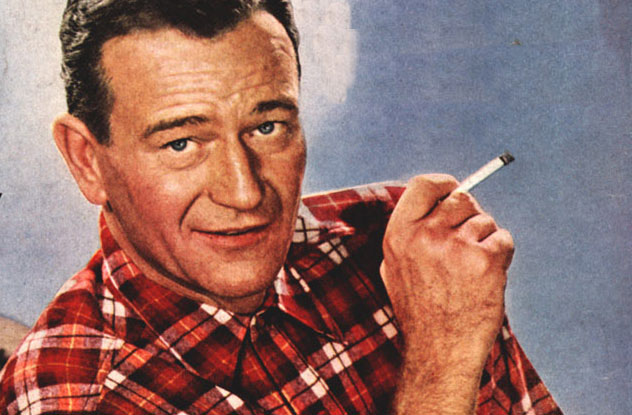
Photo via Stanford School of Medicine
Wayne’s greatest film successes came as a Wild West lawman. His most inappropriately cast role, on the other hand, was surely the Mongol warlord Genghis Khan in the 1956 film The Conqueror. The movie was excruciatingly unwatchable on its own, and its ugly legacy makes it even worse.
Much of the film was shot on location in Utah, downwind of Nevada’s nuclear test sites. In the years that followed, nearly half of the people on set were diagnosed with cancer, including two of Wayne’s own sons. John himself battled cancer in his later years (he coined the term “The Big C”). In 1964, pulmonary cancer cost him four ribs and his entire left lung. He died of stomach cancer on June 11, 1979, aged 72.
Wayne dismissed the “Curse of The Conqueror.” He believed his cancer was a consequence of smoking. This makes perfect sense; he had a six-packs-a day-habit.
In 1985, Wayne’s estate allowed the use of his name for the John Wayne Cancer Foundation, which advocates various programs to fight the disease.
8Marion And The Duke

Photo credit: Fox Film Corporation
John was born Marion Robert Morrison on May 26, 1907. His parents had a strange affinity for the name “Robert,” and they decided to squirrel it away for the next child, so Marion’s middle name was changed to Michael.
When Marion roamed the neighborhood, he never went anywhere without his Airedale terrier Duke at his side. The two were such constant companions that local firefighters began calling the boy “Little Duke.” The nickname stuck for life. He certainly preferred it to the feminine “Marion.” (Another famous Marion who hides behind a nickname is Death Row Records founder Marion “Suge” Knight).
When the man began working in film, studio bigwigs were no more impressed with his name than he was. He appeared as “Duke Morrison” in 1929’s Words and Music, and in 1930, director Raoul Walsh and Fox Studios executive Winfield Sheehan started billing him as “John Wayne.” The young actor had no say in the matter, and he was largely ambivalent about the name. He preferred to go by “Duke” with those in his inner circle.
7Football Career

Photo credit: John Wayne Enterprises
John Wayne stood at 193 centimeters (6’4″). That’s tall today, and for a man born over 100 years ago, it was massive. Young Marion easily scored a football scholarship to the University of Southern California, playing as an offensive tackle. Then, as now, college athletes weren’t paid, and Coach Howard Jones found him a job working for Fox Studios as a laborer and prop man.
While out body surfing with a friend on Balboa Beach just before the start of his junior year, Marion got caught up in a huge wave and smashed against the sand, badly injuring his shoulder. He tried to continue football, but he was too hurt to play well. Coach Jones moved him down on the roster and denied him his meals. Hungry and strapped for cash, the young man quit football and devoted all his time to Fox Studios.
6Draft Dodging

Many of John Wayne’s major roles showed him as a war hero, but he never actually served in the military. Born in 1907, he was too young to participate in World War I. By the time the US entered World War II, he was 34 years old and just beginning to become famous.
He also had health issues, including a bad back (from performing his own stunts), chronic ear infections, and the torn shoulder muscle that derailed his football career. Had he actually undergone a physical, he might have been classified as 4-F, or unacceptable for military service. Instead, his studio successfully applied for him to receive a 3-A deferment (“hardship to dependents”) because he had a family.
Given his fame, Wayne would likely have been granted a ceremonial role if he had enlisted. Yet he likely he did more for the war effort by appearing in films that glamorized the military. He also applied to work for the OSS during the war, and he spent months doing USO appearances for the troops.

BUY IT NOW
5Chess

Photo credit: Paramount Pictures
One of Wayne’s favorite pastimes was playing chess. He was a skilled player but was not beyond using duplicitous means if he could get away with it.
While shooting 1970’s Chisum, he became friendly with Christopher Mitchum, the son of Hollywood legend Robert Mitchum. John invited Christopher to play chess, and the young man was flabbergasted to find Wayne was cheating, moving two pieces simultaneously while using his big hands to block Chris’s view.
At first, Christopher didn’t know what to do, and he complained to veteran actor Ed Faulkner, who’d worked with Wayne on several projects. Ed advised Christopher to call John out on it.
The next game, John was up to his old tricks, and Christopher told him, “Excuse me, Duke, but you’re cheating.” Wayne was unperturbed, responding, “Well, I was wondering when you were going to say something. Set ’em up. We’ll play again.”
Get free shipping, thousands of movies, and millions of streaming songs with a FREE trial of Amazon Prime at Amazon.com!
4Wayne’s Boxer Relative

Photo credit: Túrelio/Wikimedia
American boxer Tommy Morrison briefly held the WBO and ICB heavyweight championship titles. He portrayed mulleted Tommy “The Machine” Gunn, the main antagonist, in Sylvester Stallone’s Rocky V. He also happened to be John Wayne’s grandnephew, and he went by the nickname “The Duke.”
While Morrison had some success in the ring, he seemed almost doomed from the start. His father was an abusive alcoholic, and his mother had gone on trial for murder. His older brother Tim did 15 years in prison on a rape conviction. In 1996, Morrison announced that he’d contracted HIV due to a “permissive, fast, and reckless lifestyle.”
In the years that followed, he dropped out of boxing and had frequent brushes with the law. He also went through a survivalist phase in which he slept in a cave, convinced the world would soon end. In 2006, he emerged to say that the original HIV tests had actually been false positives, and he was free of the disease. He tested negative in 2007, likely due to tampering with blood samples. In 2011, Quebec required him to take a supervised blood test if he wanted to box in the province, and he refused.
Morrison in fact still had HIV, and he did very little to fight his infection. HIV-positive Magic Johnson reached out to him, but he didn’t respond. He only spent a month taking the AZT antiviral drug. Morrison withered away and died of AIDS-related complications in 2013 at age 44 after spending over a year bedridden.

BUY IT NOW

BUY IT NOW
3Yakima Canutt

John Wayne would seem the last person to adopt the typical Hollywood affectation over appearance. You would have never seen him at the plastic surgeon trying to preserve his youth with Botox. But after his hair began thinning in the 1940s, he did begin wearing a wig for movies and certain public appearances, probably at the request of the studio. Yet he made no secret that he was bald; when hanging out with family and friends, he would always go au naturel, and he was not shy about being filmed or photographed without his hairpiece.
In 1974, he appeared at Harvard University, where he unflinchingly stood up to a fusillade of questioning from the student body. Though pushing 70, he had a ball with the kids. One student asked, “Where did you get that phony toupee?” He replied, “It’s not phony. It’s real hair. Of course, it’s not mine, but it’s real.”
1Red Meat

Photo credit: RKO Radio Pictures
Perhaps the most laughably disturbing rumor about John Wayne was that, upon his death, an autopsy found several pounds (40, say some sources) of undigested red meat lodged in his digestive tract.
The story checks all the boxes of a tantalizing urban legend—a famous personality, death, dietary excess, bowel movements (or lack thereof). However, it can be immediately dismissed without even considering the biological impossibilities. John Wayne was 72 years old when he died and had been ravaged by cancer for a long time. There was little doubt that he’d succumbed to natural causes, so he didn’t receive an autopsy.
Unfortunately, this story could be applied to Elvis Presley, who died at the young age of 42. Elvis had a congenital twist in his colon and a history of drug and laxative abuse. When he died, he had a great deal of chalky feces lodged in his colon.

Buy Now

Buy Now
source ==> https://listverse.com/2014/06/19/10-awesome-things-you-should-know-about-john-wayne/
Tuesday, October 3, 2017
John Wayne, his long 15-year fight against cancer

John Wayne is one of the most influential American actors in film history. Born Marion Morrison on May 26, 1907, "The Duke" played in over a hundred feature films, especially Westerns. For several generations of moviegoers, he is the incarnation of the American spirit, with his big mouth and his hat. While Arte broadcasts this Sunday April 9 Hatari !, we propose to you to return on the last years of the life of the actor and on the disease which prevailed, the cancer. An illness contracted on a shoot and that did not take that he ...
In 1956, John Wayne took the title role of Dick Powell's film The Conqueror. This adventure film tells the story of Temujin (John Wayne), the future Genghis Khan, and his brother Jmuga (Pedro Armendariz) through many intrigues and battles. If this feature was far from a success, this failure was the younger of the concerns of the actors a few years later. Because the film was shot in 1953, in the Nevada Desert near Yucca Flat. It was here that the US Army was carrying out its nuclear tests in the open air.
46 people who died
For four months, the film crew is exposed to radiation 400 times the dose normally supported by the human body. Logically, the devastating consequences are not long in coming. Of the 220 people involved in the shooting, 91 have developed cancers and 46 have died, including director Dick Powell and actor Pedro Armendariz, both of whom died in 1963

Lung and stomach cancer
If death did not strike John Wayne as quickly, he nevertheless contracted lung cancer in 1964. Its very large consumption of cigarettes did not of course helped ... In 1973, it is operated with open heart and his situation does not improve since he is also contracting stomach cancer. On January 12, 1979, he undergoes another very heavy operation, during which almost all his stomach is removed. After a few months of worsening health and a final public appearance on April 9 at the Oscars, John Wayne died of his illness on June 11, 1979 at the age of 72. He leaves behind a hundred films and the image of an actor still immortal.

source ==> https://www.telestar.fr/culture/john-wayne-son-long-combat-de-15-ans-contre-le-cancer-274539
Monday, October 2, 2017
Why john wayne didn't serve in military

No one was more a hero in World War II than John Wayne. At least that’s what the aliens will think when they view the historical footage documented in old Hollywood reels such as the Sands of Iwo Jima (1949), Flying Tigers (1942), and The Longest Day (1962). Of course, we know better now. But if you’re a child of World War II, who reveled in the Duke’s onscreen heroics while welling up with pride, maybe there’s still some wiggle room to take solace in. For everyone else, fire away.
John Wayne received a 3-A deferment from the draft for family dependency since he was a father of four and had just made Stagecoach(1939) as a then unknown actor. That film also began a career of collaboration with John Ford, the iconic director who had his eye on Wayne since his days as a football player at USC and the numerous stand-in and stuntman roles he performed in previous westerns.
At the time, the studio was adamantly opposed to Wayne for the role, but Ford’s casting obviously had prescience. For his part, Wayne wanted to do a few more movies to secure his future place in Hollywood and then sign up for the war that reached American shores in December 1941. So his case for deferment was strictly on a temporary basis.
Thirteen wartime movies later, and the flag of heroism he rose in the said Sands was still awaiting his recruitment in real-life. And this was a fact that John Ford, now a commander in the U.S. Navy, never shied away from letting the Duke know about. He would frequently berate Wayne “to get into it,” saying that he was growing rich as other men died.

Buy Now
The latter apparently provided a powerful disincentive. And with a bevy of top-billed leading men doing their part, Wayne knew how valuable a commodity he was in Hollywood. So upping to A-movie pay was among the spoils he received in their absence.

Wayne (born Marion Morrison) was also concerned that the war would age him out of high playing action roles once the fighting finally ended. Henry Fonda, on the other hand, paused his paychecks and wasn’t looking for theater in the global drama that was playing out across the world. “I didn’t want to fight a fake war in a studio,” declared the well-known Hollywood liberal. And his performances in Mr. Roberts (1955) and Midway (1976) did not suffer from the three years he served on the destroyer USS Satterleewhere he was commissioned as a lieutenant junior grade in Air Combat Intelligence.
Jimmy Stewart also sucked it up – even if he had to live it up first. Originally denied enlistment for being too light, he fattened up on candy, beer, and bananas and was the first Hollywood star to appear in stripes. Soon flying combat missions, he eventually made colonel and became a brigadier general after the war in the Reserves.
Others serving actors were Paul Newman, Kirk Douglas, and Clark Gable. But whatever pause the bright lights and big bucks gave, procrastination went full frontal after the Duke starred with Marlene Dietrich in Seven Sinners (1940). Becoming entangled enough in an extramarital affair to make a complete sham of the original deferment, he boasted she was the best lay he ever had. However, this was not just bravado. He fell madly in love and the possibility of losing her while away in service. Again, this meant the war’s winning would have to be left to others.
In the Duke’s defense, the melodramatics of hooking up with Dietrich wasn’t nearly as fair a fight as WWII or on par with the mundane marital bliss that others left behind. “When she came into Wayne’s life, she juicily sucked every last drop of resistance, loyalty, morality, and guilt out of him, and gave him a sexual and moral cleansing as efficiently done as if she were draining an infected sore,” wrote Marc Eliot, in American Titan: Searching for John Wayne.

This is all author Eliot needs to know. Indeed, he even suggests that claims of Wayne begging John Ford to find him a place among the real heroics “are a complete fabrication.” Dan Gagliasso of Breitbart disagrees and cites Ron Davis’ Duke; the Life and Image of John Wayne to make a case that John Wayne did at least make an effort to join up.
A May 1942 letter by Wayne to Ford begins Gagliasso’s argument. “Have you any suggestions on how I should get in? Can you get me assigned to your outfit, and if you could, would you want me? How about the Marines? You have Army and Navy men under you. Have you any Marines or how about a Seabee or what would you suggest or would you? No I’m not drunk. I just hate to ask for favors, but for Christ sake you can suggest can’t you? No kidding, coach who’ll I see,” said the letter found among the John Ford Papers at Indiana University.
This to Gagliasso doesn’t sound like someone shirking his duty and examines what Ford would have to gain by leaving Wayne out to dry. With the Duke’s star climbing, Ford must have seen the chance to ascend with his highly bankable friend and asset. At the same time, the manipulative and sadistic side many attribute to Ford would then have something to hold over Wayne by playing the coward card at will.
Either way, no response to Wayne’s letter has been found, but official documentation of Wayne’s intent was discovered in 2003. The National Archives contain a letter of application from Wayne to the OSS.
Ford’s grandson provides a secondary source for the documentation. Dan Ford recalled that his grandfather told him that OSS Commander William Donovan approved his application to a forward photography unit. But the deployment never occurred because the paperwork was sent to the home of his estranged wife.
Since Wayne had already left the home of his then-wife Josephine, she certainly would have had good reason to withhold the letter. If he died in the war, she alone would be left to provide for their four children.

Even so, a follow-up is nowhere to be found, and with all the officer slots filled by 1943, joining the ranks alongside GI Joes didn’t quite provide enough impetus. “I felt it would be a waste of time to spend two years picking up cigarette butts. I thought I could do more for the war effort by staying in Hollywood,” Dan Ford recalled his father saying during another conversation.
The movie star definitely had a point about the impact he could have by inspiring the nation and its war bond efforts. It’s certainly a convenient reason, but it’s also enough to allay the personal guilt and put off the hypocrisy he had to feel about playing war on the silver screen.
Here’s another possible answer to his inaction. In 1948, John Wayne became president of The Motion Picture Alliance for the Preservation of American Ideals. This included actors Ward Bond and Adolphe Menjou, MGM producer James McGuinness, and director Sam Wood. Their goal was hunting down subversive elements within the American film industry.
Hating communism, Wayne found a cushy place for his overcompensation to reside. In addition, fervently backing the blacklist by the House Un-American Activities Committee let him join a fight on the front lines of where the war was being waged and further satisfy his rationalizations.
In accordance, he starred in Blood Alley (1955) and Big Jim McLain (1952), the latter of which was based on the actual case of the “Hawaii 7” (suspected communists charged with advocating the overthrow of the American government). Wayne played a big damn American hero in that movie… who worked as an investigator for HUAC.

A less sympathetic depiction of that time period was presented in last year’s Trumbo where Wayne is portrayed as a mindless tool for rightwing columnist Hedda Hopper.
But if you really want to get deep and find some psychological projection, his disdain for Vietnam protestors and draft dodgers sounds like a cry for help. “As far as I’m concerned, it wouldn’t bother me a bit to pull the trigger on one of ‘em,” Wayne once stated. Subsequently, The Green Berets(1968) was a Vietnam War fantasy where an aging Wayne defeated the North Vietnamese while being applauded by a cynical, left-leaning press that had suddenly learned the error of its ways. His final wife Pilar Wayne did offer some empathy for his increasingly erratic political stances. “He became a super-patriot for the rest of his life, trying to atone for staying home during WWII.”
Garry Wills is not so sympathetic in his book John Wayne’s America, which served as the basis for TruthDig's scathing indictment.
“He was, in reality, a draft dodger. America’s archetypal soldier was in fact a chicken hawk. He was a cheerleader and champion of militaristic patriotism and combat he had never experienced. Wayne had ‘other priorities’ during WWII—achieving superstardom (and saving his neck) was more important than defeating fascism. Much like Vice President Dick Cheney, who sought numerous deferments during the Vietnam War, Wayne was the quintessential war wimp.”
He learned as much on USO tours in Australia and throughout the Pacific where he was greeted by boos from war hardened vets. On the other hand, if the discussion is raised on social media, you will definitely find those who take comfort in the symbol the Duke represented as they viewed from the sidelines as children.

As Ray Davies of the Kinks penned in the song “Celluloid Heroes,” “I wish my life was a nonstop Hollywood movie show.” We clearly see denial definitely beats the real thing.
Fantasy and nostalgia aside, John Wayne did write a few letters, there’s documentation to prove it, and it’s plausible that his wife withheld the paperwork. But would a real American hero not show up at the OSS and get some clarity? Maybe not if fear, opportunity, and Marlene Dietrich were all pulling in the other direction.
source == > http://www.denofgeek.com/us/movies/john-wayne/252904/john-wayne-the-world-war-ii-hero-who-didnt-serve
Subscribe to:
Posts (Atom)